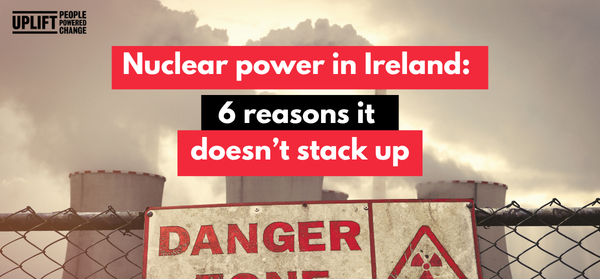
We all want to be able to heat our homes, cook dinner and get from A to B with clean, cheap, reliable energy. The solution is more renewable energy, like wind, solar and battery storage. A nuclear distraction will only push us further off course.
People in Ireland have the most expensive energy bills in Europe, thanks to our reliance on imported fossil fuels. It’s why Trump’s illegal war in Iran has sent our energy bills skyrocketing.
It’s clear we need to take control of our own energy system. We have the technology ready to produce all of our energy here in Ireland — from clean wind, sunshine and batteries. But cashed-up lobbyists for big tech and fossil fuel companies are trying to distract from this future by talking up nuclear power as a “magic bullet” solution instead. The longer they delay action, the longer they can keep profiting off their toxic product.
The truth is, nuclear simply doesn’t stack up in Ireland. It’s too slow, too expensive and too risky. It’s time for this Government to stop wasting time and start investing in the homegrown renewable energy that will cut energy bills and climate pollution right now.
Here are 6 reasons why nuclear doesn’t stack up for Ireland:
- It would take decades to build, but we need cheap, clean energy now
Ireland has no existing nuclear industry, expertise or workforce, and has a legislative ban on nuclear energy. All of these barriers would need to be overcome if we were to build nuclear reactors here, which means they wouldn’t start supplying energy for more than 30 years, likely much longer. [1]
Even countries with existing industries can’t build nuclear reactors quickly. The UK’s flagship nuclear project, Hinkley Point C, is now costing more than double what was promised (upwards of £35 billion) and is expected to open 14 years late in 2031. France’s plans for six new nuclear reactors, announced in 2022, continue to face delays with experts saying the plan is “far from ready”. [2]
We can’t afford to wait decades longer for clean, cheap energy, especially with data centres already stealing more than 20% of our energy. Technologies like solar, wind and battery storage are ready to be rolled out and is already helping families across the country save on their energy bills. [3]
- We would pay more for it
Building nuclear reactors is costly. Independent modelling consistently shows solar and wind are now the cheapest forms of energy to build. [4]
Renewable energy is only getting cheaper, while nuclear projects continue to run over budget – and these costs are often passed on to taxpayers. In the US, NuScale decided to scale back and ultimately cancel its Small Modular Reactor project after costs blew out to US $9.3 billion. In the case of the Hinkley Point C project in the UK, once it’s connected to the grid, taxpayers will have to give £2bn a year in subsidies to the private company that owns it. [5]
We already have the most expensive electricity in Europe. [6] We need renewable energy solutions that can bring these costs down, not huge cost blowouts.
- It would suck up huge amounts of water
Nuclear power is one of the thirstiest forms of energy production. With big data centres already bleeding our rivers dry, we can’t afford to put our precious water supply under even greater pressure. [7]
Huge amounts of water are used to cool the nuclear reactors that produce electricity. A typical 1600 MW nuclear facility uses 2,000 litres per second. That’s roughly what a household uses over a whole week! [8] Wind and solar, on the other hand, use very little water. [9]
We need water for our homes, farms and wildlife – not to help more big companies turn a profit.
- It puts our communities, health & environment at risk
Nuclear has too many risks: for our health, environment, the safety of our communities, and future generations.
All reactors create nuclear waste. This radioactive waste lasts longer than any human civilisation has existed, and there is no proven, safe long-term solution to store it. In the US, nuclear waste has been piling up on some installation sites for decades because there are no suitable storage sites. [10] No community should have to bear the burden of hosting dangerous nuclear waste.
The impacts of radiation from the Chernobyl disaster in 1986 and Fukushima in 2011 are still being felt today. Hundreds of thousands of people were impacted, and large areas of land and water are still contaminated. [11] While rare, the risk of disaster can’t be ruled out.
Nuclear power stations also run on uranium. This is not a renewable resource and must be mined, with devastating impacts on water supply, communities and health. [9] We would also still depend on other countries to import uranium, still leaving us vulnerable to international shocks. For example, the Russian company Rosatom currently supplies over half of the world’s uranium. [12]
In the 1970s, there were huge protests against nuclear power in Ireland. [13] In 2026, the argument is still the same: it’s simply not worth putting our children and future at risk.
- We don’t need it
According to experts, the size of Ireland’s energy grid and the amount of existing renewable energy make it unsuitable for nuclear power. There is a long list of other priorities – including connecting up the grid and investing in more wind and solar – that will make our energy cheaper, cleaner and more reliable. [14]
A standard nuclear power station is 1200MW, which is too large for our island’s electricity system. While many people talk about the potential of Small Modular Reactors (SMRs) this technology isn’t proven: it’s not operating commercially anywhere in the world. In fact, the most advanced SMR project was recently cancelled in the US after huge cost and time blowouts. [15]
At best, SMRs will be a mature technology in 15-20 years, in which time we could already be producing all our own renewable energy through a combination of “variable” energy sources like solar and wind, and “dispatchable” sources that can be quickly ramped up and down like battery storage. [16]
- It’s a distraction from the solutions we really need
This Government knows that nuclear power doesn’t stack up for Ireland. It’s a fake debate that benefits them and their friends in big tech and fossil fuel companies.
By talking about nuclear, politicians can distract from the real solutions that experts are calling for and that the government is dragging its heels on. Things like: support to help more people get rooftop solar and batteries; a pause on energy-hungry data centres; and more investment in public transport, solar and wind. [17]
Delaying action is precisely what lobbyists for big tech and fossil fuel companies want. The longer they can delay government spending on green, cheap energy, the longer they keep profiting off selling us their dirty oil and gas and helping prop up energy-hungry data centres. [18]
The truth is, renewables are cheaper, cleaner, faster – and already helping cut energy bills in Ireland today. That’s what we should be focusing on.
After reading, can you let us know your thoughts? We’d love to know:
- Did you learn something new?
- Did it shift your opinion on nuclear?
- Do you still have other questions?
NOTES
- Ireland’s nuclear debate generates a lot of hot air but no clean energy | Irish Times
- Hinkley Point C could be delayed to 2031 and cost up to £35bn, says EDF | The Guardian & France ‘far from ready’ to build six new nuclear reactors, audit body says | France24
- ‘It’s a slap in the face’ – Irish households are paying twice as much for electricity as data centres | Irish Times & Wind and solar farms saved Irish consumers €840m since 2000 | RTE & Why more Irish homes than ever are opting for Solar | RTE
- Levelized Cost Of Energy | Lazard & More than 90% of new renewable energy capacity is now cheaper than fossil fuels, study shows | EuroNews
- UK energy bill payers will hand £2bn a year to EDF for new power stations | The Guardian & NuScale cancels first-of-a-kind nuclear project as costs surge | E&E News
- Ireland has most expensive electricity prices in European Union – Eurostat | RTE
- 5 reasons we don’t need data centres – and why we need to campaign against them | Friends of the Earth & Water scarcity set to be a growing challenge for European data centres | Sustainability Online
- Cooling Power Plants | World Nuclear Association & Water Conservation | Uisce Éireann
- Wind and solar can save the planet — can they save our water supply, too? | Grist
- Nuclear Waste Is Piling Up. Does the U.S. Have a Plan? | Stanford University & The true toll of the Chernobyl disaster | BBC & A decade on Japan is still grappling with the environmental impact of Fukushima | Chemistry World
- Renewed interest in uranium mining threatens waterways and wildlife | Frontier Group & Uranium mines threaten African people and nature | SOMO & The Hidden Pollution of & Uranium Mining in Kazakhstan | Vlast
- Europe struggles to end reliance on Russian uranium | Financial Times
- Ireland’s Woodstock: the anti-nuclear protests at Carnsore Point | HeadStuff
- Ireland is still too small for a nuclear power plant | Irish Times
- NuScale cancels first-of-a-kind nuclear project as costs surge | E&E News
- Ireland’s Nuclear Power Debate Has a Grid Problem | Energy Central
- From Crisis to Security – Ireland’s Path to Fair Bills and Clean Energy | Friends of the Earth & Ireland’s nuclear debate generates a lot of hot air but no clean energy | Irish Times
- Data centres ‘cannibalising’ renewables as Ireland warned of fossil fuel ‘energy shock’ | Journal & The oil, gas and arms companies profiting from the war on Iran | Middle East Eye