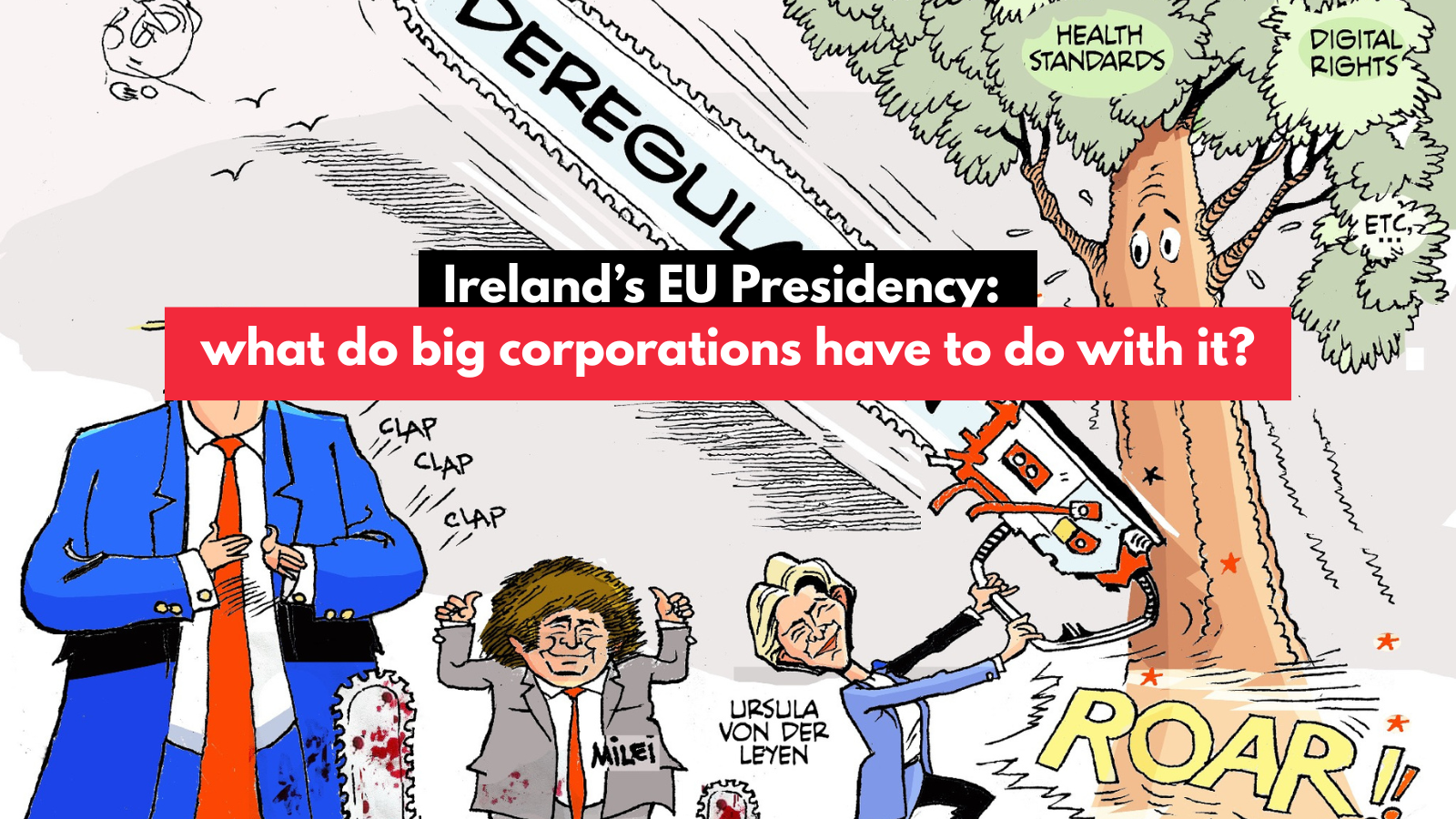
Cartoon by Khalil Bendib, via Corporate Europe Observatory
Right now, the EU laws that are meant to protect our food, workplaces, and environment are under attack. We’re witnessing the biggest “deregulation agenda” in the history of the EU – driven by big corporations and their cashed-up lobbyists, who want to make it easier to exploit people and our planet for profit.
With so much at stake, Ireland’s EU Presidency is more important than ever. From now until the end of the year, this government is responsible for overseeing big EU-wide decisions which could either keep us safe, OR hand more power to corporations who are only interested in their profits.
That’s why we gathered a group of experts together for a webinar in July, to discuss how corporate lobbying is happening in the EU, how it’s impacting us here in Ireland and what we can do to fight back. Here’s what we learnt:
The EU “deregulation agenda”
Olivier Hoedeman from the campaigning group Corporate Europe Observatory explained how this race to the bottom is being driven by corporate lobbyists, who want to make it easier to profit off people and our planet.
The main method of deregulation is called an “omnibus” – a technical word for a piece of legislation that changes several laws in one go. These changes are being rushed through extremely quickly, without the proper checks and balances.
The Commission has invented a new form of ‘consultation’, where they handpick who they would like to hear from, instead of allowing everybody to participate. A recent report showed that 70-80% of stakeholders in these consultations are business lobbyists, rather than the usual democratic mix of civil society groups, trade unions etc.
The scale is huge. 12 omnibus have already been proposed, and President of the European Commission Ursula von der Leyen has signalled that the whole body of existing EU laws – tens of thousands of them – will be assessed over the next few years.
As well as these omnibus, the Commission is looking to simplify the permits for certain projects, predominantly in dirty fossil fuels and mining, by labelling them as “public interest”. Not only would this give them accelerated permits, it would also bypass normal environmental assessments and make it harder for communities affected to resist
Learn more:
- This is what corporate capture looks like | Corporate Europe Observatory
- Permission to pollute: EU rips up permit rules and funds dirty infrastructure | Corporate Europe Observatory
What does it mean for Ireland?
Workers rights
Ciaran Nugent from the economics Neri Institute explained the dangers of deregulation for workers, through the example of “the 28th Company Regime” – what’s now being called “EU Inc.”
Under this proposal, announced in March 2026, any company would be able to register in a different country to where they employ workers, regardless of where they have economic activities and where workers are employed. It’s something that’s been lobbied for directly by a coalition of companies, especially those from big tech.
There are huge concerns that this means workers would be covered by the labour laws of the country the company is registered in, NOT of the country where they work. This would allow companies to set up in a country they have little or no activity in, but which conveniently has low standards on wages and workers’ rights.
How we fight back?
Irish MEP Michael McGrath is the European Commissioner for Democracy, Justice, the Rule of Law and Consumer Protection and the one in charge of the EU Inc proposal. We know he’s vulnerable to being targeted in his local constituency – and the Uplift community has done it before!
Learn more:
Human rights
Evie Clarke from the Irish Coalition for Business & Human Rights shared how corporations have already been able to roll back hard-fought climate and human rights protections.
The Directive on Corporate Sustainability Due Diligence (CSDDD) was formally adopted by the EU in 2024, after years of campaigning by human rights groups. It was designed to move away from voluntary corporate responsibility (where companies were encouraged to assess risks and act responsibly, but there were no legal obligations or enforcement) to mandatory requirements for companies to identify, prevent and address human rights and environmental harms connected to their activities. This was a landmark victory for human rights, with Ireland supporting the CSDDD throughout the negotiations.
The CSDDD was only in place one year before it was gutted in December 2025. It has diluted enforcement mechanisms, weakened obligations around stakeholder engagement, and completely removed requirements for companies to adopt climate transition plans.
How we fight back?
ICBHR has been getting active with joint public actions and briefings for politicians to draw attention to the harm this deregulation agenda is causing. With EU member states required to bring the newCSDDD into national law by July 2028, there is also an opportunity now for Ireland to not only restore but strengthen some of the things that the EU have gutted.
Learn more:
- EU’s “Deregulation” agenda claims its first victim: Corporate Sustainability Due Diligence Directive gutted | European Coalition for Corporate Justice
- Defending the CSDDD: Ireland’s role in protecting the EU Corporate Sustainability Due Diligence Law | Irish Council of Business & Human Rights
Climate
Deirdre Duffy from Friends of the Earth Ireland pointed out the huge costs to deregulation that governments are turning a blind eye to. Deregulation shifts the risk away from corporations onto us – harming our communities, driving up energy bills, polluting our water and air, and fuelling more dangerous climate impacts.
She argued that the EU’s focus should be on “de-fossilisation” – transitioning our energy system, transport and industries to be powered by clean, cheap renewable energy. Deregulation is taking us in the opposite direction, where the interests of big polluters are prioritised first, and we’re seeing this mindset seep into Irish politics too.
Big tech and fossil fuel companies have huge influence over government policies in Ireland. For example, the Large Energy Users Action Plan published in January says that data centre representatives would be brought into the department for a summit on the industry. Minister Jack Chambers has also pushed through legislation to sidestep Ireland’s landmark Climate Law for projects the government deems “critical infrastructure”, allowing projects like Shannon LNG to be fast-tracked without environmental safeguards.
How we fight back?
Join the campaign to stop a giant floating gas terminal being built in the Shannon Estuary – you can sign the petition from Not Here Not Anywhere here.
Get behind calls for a moratorium on new ai data centres – you can sign Friends of the Earth’s petition here.
Learn more:
Big tech
Siobhán O’Donoghue from Uplift explained how Ireland has an outsized responsibility – and opportunity – to regulate big tech companies and the harm they are causing.
Two proposed EU omnibus are trying to strip back critical protections for people online, including scaling back the data privacy law GDPR, and delaying the AI Act that puts rules in place for how AI is used. As Ireland currently holds the EU Presidency and is home to the Data Protection Commissioner (the lead regulator for GDPR enforcement in the EU), the Irish government is the most important body that has the power to act.
But Ireland’s unhealthy economic dependence on big tech has created a situation where these companies have an extraordinary influence on government policy. Big tech billionaires are only interested in harvesting our data and keeping people glued to their screens, no matter the impact on our health, safety and democracy.
How we fight back?
Breaking the media and political narrative that ties big tech to the prosperity of people in Ireland is key. As long as we are caught in this cycle that ‘there is no alternative,’ this government will continue to let big tech off the hook. Ai data centres and harmful algorithms are having real impacts on our health, energy bills and water supply. With Ireland hosting the EU Presidency right now, we have the opportunity to focus media attention on these issues.
Learn more:
- The AI Omnibus: Fast-Tracking Deregulation, Weakening Digital Rights | Civil Liberties Union for Europe
- Joint statement: The EU must uphold hard-won protections for digital human rights
How we fight back
The good news is – there’s lots of amazing work and coalitions forming to fight back against this deregulation agenda.
We’re seeing more and more national governments come under pressure, with Spain recently speaking out against what’s happening. The more we join together, across organisations and issues, the more powerful we are to push our governments to act and stop big corporations eroding the laws that protect us.
Find out more about some of these coalitions below or sign up here to get involved.
Rules to Protect Coalition (EU)
This coalition brings together hundreds of trade unions, climate and environmental groups, digital rights groups, corporate accountability and financial justice organisations, civic and democracy groups, social rights advocates and more from across the EU. The purpose is to help each other campaign against specific omnibus proposals, but also to fight the wider deregulation narrative.
Stop the Chainsaw / Kettensäge Stoppen (Austria)
Civil society groups in Austria have come together to create a space where people can understand what’s happening on deregulation and to bring all the different topics together. They are working to tell the bigger story of how deregulation weakens the standards and laws that are meant to protect us all. They’ve held public events, workshops and open letters to call on the government to act.
In the absence of government scrutiny, CorpWatch Ireland is a watchdog for corporate power. The coalition is helping to expose the insidious ways that corporate capture is impacting our lives and bring people together to build a better system.